
4.3.3 Inputing Vertical and Lateral pitch for fingers
Forward
and
4.3.3 measurement
Fingerpitch is
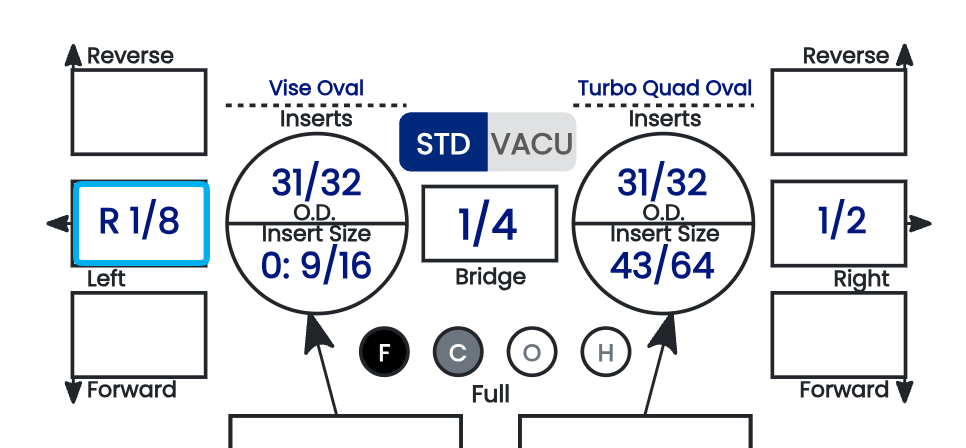
enteredPitch describesinto the anglepitch attiles whichsurrounding each finger hole is drilled intoon the ballspec —sheet. notThere's straight down, but tilted in a specificno direction to match"select" — the naturaltile restingyou angle ofput the bowler'svalue finger.in Spectreis Cloudthe recordsdirection. twoThis pitchpage valuescovers how to read and enter those tiles for each finger hole: vertical pitch (the tiltmiddle towardand orring awayfingers.
🛠️ How the bowler'sPitch palm)Tiles and lateral pitch (the tilt toward or away from the thumb). Entering both values accurately is essential to a comfortable, repeatable fit.
📐 Understanding Vertical PitchWork
Vertical pitch describes the angle of theEach finger hole alongis framed by pitch tiles, and the palm-to-fingertiptile's axisposition — that is, whetheron the holesheet tilts toward the palm (forward) or away from it (reverse).
Typical vertical pitch ranges for fingers
pitch:
- ✅
Fingertip grip:Forward¼"toalways½"pointsforwardistoward themost common starting range for bothmiddleandofringthefingers.sheet. Enter your forward pitch in the forward tile. - ✅
Conventional grip:0"to¼" forwardis typical — conventional bowlers generally need less forward pitch than fingertip bowlers. ❌ Vertical pitch beyond¾" forwardfor fingers is unusual and should be confirmed before drilling — it may indicate a measurement error or an atypical hand anatomy that warrants a closer fitting.
↔️ Understanding Lateral Pitch
Lateral pitch describes the angle of the finger hole along the thumb-to-little-finger axisReverse — whetheralways the hole tiltspoints toward the thumbouter side of the handsheet. orEnter awayyour fromreverse it.
You don't set a direction from a dropdown — you enter the value in the tile that corresponds to the direction you want. Forward/reverse and lateral are separate tiles, so a finger can carry both at once. Note: To apply a pitch against a tile's default direction — for example, Right pitch on the left finger — scroll to the absolute bottom of that tile's drop-down. There you'll find values listed as Note: On fingertip fits, it is quite rare to see forward pitches on the fingers — most fingertip finger pitch is zero or reverse. Treat a | a ⚙️ Finger Pitch Is Fully ManualThere is no automation for finger | |
Typical lateral pitch ranges for fingers
✅Most bowlers:0"to¼" toward thumbfor both middle and ring fingers.✅ Middle and ring fingers often carry the same lateral pitch, but they do not have to — record each finger independently.❌ Lateral pitch beyond3/8"in either direction for finger holesisuncommonmanualanddataworth double-checking.
🛠️ Entering Pitch Values inentry. Spectre Cloud records exactly what you type, with no auto-suggestion and no error validation behind these fields, so accuracy is entirely on the person entering it.
📋 Entering Finger Pitch — Step by Step
InLocate the specpitch sheet,tiles locatearound the pitch section for the middle finger and ring finger — each finger has its own vertical and lateral pitch fields.holes.- For each finger, enter the
verticalforward pitchor reverse value in the correct tile — theforward amountpoints in inches (e.g., ¼, 3/8, ½) — and selecttoward the direction:middle Forward,of Zero,the orsheet, Reverse.reverse toward the outer side.
- Enter the lateral
pitch value and selectin the direction: Toward Thumb, Zero,Left or AwayRight fromtile Thumb.as needed.
- Repeat for both
the middle and ring finger.fingers.
- Review all
fourthe finger pitch entries (vertical + lateral for each finger) before moving on to thumb pitch.
¼3/8½ForwardZeroReverseToward ThumbZeroAwayRight fromtile ThumbVerify with Spectre team: confirm whether pitch is entered asfractioncross-direction pitch (e.g., ¼")Right or a decimal (e.g., 0.25"), and whether direction is selected via a dropdown, radio buttons, or a +/− toggle. Also confirmon the exactleft fieldfinger), labels used inuse the UI.
Rx 📋values Howat Pitchthe Is Recorded on Fitting Sheets
Legacy and handwritten fitting sheets record pitch in a varietybottom of ways. Here is how to interpret the mostdrop-down.
common notations when transferring records into Spectre Cloud:
| |
| |
| |
| |
| |
|
✨ Tips for Accurate Pitch Entry
✅ Enter middle finger pitch and ring finger pitchseparately— they are often the same, but do not assume. Many bowlers carry slightly different pitches on each finger.✅ When in doubt on lateral pitch for a new bowler,0"to¼" toward thumbis a safe starting point. You can refine on future visits.✅ If a bowler reports finger soreness or difficulty releasing after a drilling, pitch is usually the first adjustment to consider — noting the original pitch values accurately makes future corrections much easier.❌ Do not confuse vertical and lateral pitch fields when entering data from a handwritten sheet — double-check the axis before saving.❌ Do not leave pitch fields blank if the original fitting sheet shows zero — enter0"explicitly so the record is unambiguous.
IBPSIA tip: Spectre Cloud's auto-suggestion feature can recommend starting pitch values based on grip type and span measurements. These are reference points, not prescriptions — always defer to a measured fitting or a returning bowler's known preferences over a suggested value. See 4.5 — IBPSIA Auto-Suggestions for details.
Related Sections
- 4.3.2 — Entering span measurements
(Full Span and Cut to Cut) - 4.3.4 — Inputting thumb pitch
- 4.1.4 — Pitch terminology: Forward, Reverse, Lateral, Zero
- 4.2.4 —
How to identifyIdentifying grip type from a measurement sheet - 4.5 — IBPSIA auto-suggestions
Book 05 — Oval Calculator
Tip: KeepBecause forward points to the middle of the sheet and reverse to the outer side, the sheet's own layout tells you the direction — you don't have to remember a laminatedsign pitchconvention. referenceEnter cardeach atvalue your drill press with common notation translations. When transferring a stack of legacy fitting cards, havingin the conversiontile tablethat visiblematches savesthe timedirection you measured, and preventsread the mostfinger commonpitches transcriptionback errors.before saving, since nothing here is validated for you.
```