
4.1.4 Pitch terminology
Pitch terminology: Forward, Reverse, Lateral, Zero pitch explained
4.1.4 concept
Pitch is the angle at which a finger or thumb hole is drilled relative to the centre of the ball. Adjusting pitch changes how the bowler'ball's fingercenter. orIt thumb sits in the hole — affectingaffects grip comfort, how securely the ball retentionis held through the swing, and thehow easecleanly andit consistencyreleases. ofIn Spectre Cloud, you set pitch for each hole using the release.pitch tiles on the spec sheet — the boxes framed by directional arrows around each hole. This page explains how those tiles work and defines the four core pitch terms used throughout Spectre Cloud spec sheets and settings:terms: Forward, Reverse, Lateral, and Zero pitch..
Note: This page covers pitch terminology conceptually. For the Spectredisplay Cloudand sign settings thatreferenced control how pitch values are displayed and signed on spec sheets,here, see chapter 2.4.4. For the auto-suggestion settingssuggestions that generatepropose pitch recommendations,values, see 2.6.2 and 2.6.3.3.
📐🛠️ WhatSetting IsPitch Pitch?with the Pitch Tiles
WhenOn a Spectre Cloud spec sheet, each hole — thumb, middle finger, and ring finger — has its own pitch tile. Each tile is drilledsurrounded straightby througharrows that represent the balltwo towardpitch itsaxes:
- ✅
zeroForwardpitch/ Reverse —it is perpendicular totheball'sarrowssurface at that point. Pitch is introduced by angling the drill slightly in a specific direction, tilting the hole openingpointing towardorand away from thefingers,ball'sorcenter.laterallyForward tilts the hole toward the center of the ball; reverse tilts it toward the outside. - ✅ Lateral — the sideways arrows, tilting the hole toward or away from the adjacent
fingerhole.
You enter the pitch amount ofin the tile in the chosen direction. Forward/reverse and lateral are independent, so a single hole can carry both at once (for example, a small forward pitch isand measureda insmall fractionslateral pitch together).
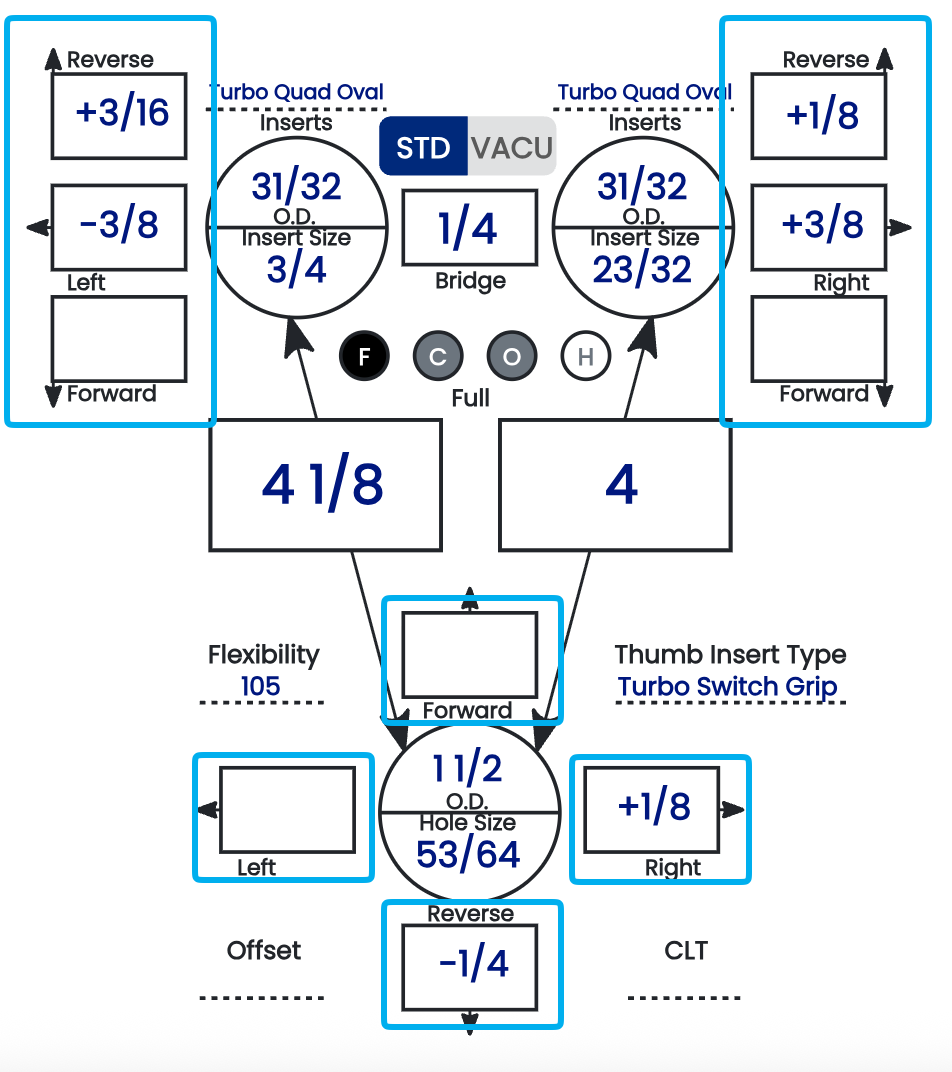
🔢 Fractions or Thousandths of an inchInch
Pitch specifically, the distance the hole's centreline at the ball's surface is offset from zerovalues in the giventiles direction.can be displayed two ways, controlled by a Spectre Cloud setting:
- ✅
PitchFractions — e.g.1/4",1/8",3/16". - ✅ Thousandths of an inch — the same values shown in decimal, e.g.
1/4"as.250"and1/8"as.125".
The value is appliedidentical either way — only the notation changes. Choose whichever matches how your drill press readout and your shop's habits express pitch, so there's no conversion in your head at the press.
⚠️ Verify with your Spectre team: confirm the exact name and location of the fractions-vs-thousandths display setting so it can be linked precisely from this page.
➕➖ Pitch Polarity (+/-)
By default the arrows around each tile carry the direction. You can also turn on polarity so a + or − sign appears in the pitch tiles, giving you the direction as a sign in addition to boththe arrows. This is set in chapter 2.4 and is worth aligning to your specific machine:
- ✅ Whether right lateral pitch reads as positive or negative — 2.4.1.
- ✅ Whether forward thumb pitch reads as positive or negative — 2.4.2.
- ✅ Whether the
thumb+/-holesigns displayandin thefingerpitchholestiles at all —though2.4.3.
Matching these to how your drill press signs its pitch is morethe frequentlysingle adjustedbest than finger pitch.
01/2"📐 ForwardThe Four Pitch Terms
Forward pitch tiltsangles the hole opening toward the fingers — the hole leans in the directioncenter of the fingertipsball. ratherIt than pointing straight towarddraws the ball's centre. From the bowler's perspective, the opening faces slightly upward when the ball is held in the delivery position.
Physical Effect
✅ Thethumb or fingeris drawndeeperintoin, increasing grip security and slowing theholeexitbyslightly.gravity and grip pressure — forward pitch increases the security of the grip through the swing.✅ Reduces the tendencyCommon forthe thumb to fall out or feel loose at the top of the backswing.✅ Can slow the thumb's exit slightly — the hole's angle works against the thumb's release path rather than with it.
When Forward Pitch Is Used
✅ Bowlers withless flexiblethumbsthumbs,—conventionalforwardgrips,pitch compensates foror athumbball thatdoesfeelsnotloose.naturally align with a zero-pitch hole.✅ Conventional grip bowlers — deeper insertion combined with forward pitch produces a secure, comfortable fit.✅ Bowlers who report the ball feeling loose or dropping early — forward pitch increases grip security.✅ Bowlers with thumb swelling or arthritis — more forward pitch eases insertion and extraction.
Typical Range
range: Most0 bowlersto use between 0 and 1/2" forward pitch on the thumb.forward; 1/4" forward is the most common IBPSIA starting point for average hand flexibility.point.
📐 Reverse Pitch
Reverse pitch tiltsangles the hole opening away fromtoward the fingersoutside —of the hole leansball, away from thecenter. fingertips, angling toward the back of the hand. From the bowler's perspective, the opening faces slightly downward when the ball is held in delivery position.
Physical Effect
✅ The hole's angleIt assists the thumb's exitpath — the thumb is more easily expelled from the hole at the moment of release.✅ Producesfor a faster, cleanerthumbrelease,exitbut— the ball transitions from thumb-in to thumb-out more quickly, increasing the window for finger lift.✅ Can reducereduces grip security ifoverappliedoverapplied.— too much reverse pitch makes the ball feel insecure through the swingCommon forbowlers without sufficient thumb control.
When Reverse Pitch Is Used
✅ Competitive andhigher rev-ratebowlersbowlers,seeking a faster, more consistent thumb exit.✅ Bowlers with highlyvery flexiblethumbsthumbs,— less forward pitch (ormild reverse pitch) accommodatesa thumb thatnaturallyhangs.sitsTypicalatrange:a flatter angle.✅ Bowlers who report the thumb feeling stuck, hanging, or causing the ball1/16" toloft — reverse pitch promotes a cleaner exit.
Typical Range
Reverse pitch is less commonly applied than forward pitch. Most bowlers who use it fall between 1/16" and 1/4" reverse. Values beyond 3/8" reverse are rare and should be verified physically before drilling. ⚠️ Verify with your Spectre team: confirm whether Spectre Cloud enforces any input range limits on reverse pitch values.
📐 Lateral Pitch
Lateral pitch tilts the hole openingsideways, toward or away from the adjacent fingerhole, holeto —relieve sideways rather than forward or backward. For the thumb, lateral pitch moves the opening toward or away from the ring finger side. For the finger holes, lateral pitch moves the opening toward or away from the centre of the bridge.
Physical Effect
✅ Lateral pitch on the thumb adjusts the thumb's natural resting angle within the hole — reducingside pinchingor relieving pressure on one side of the thumb.✅ Lateral pitch on the fingers adjusts how the finger loads against the hole edge during the release — affecting the directionandconsistency of finger lift.✅ Even small amounts of lateral pitch — as little as1/8"— can meaningfully relieve grip discomfort for a bowler whose thumb or finger geometry does not naturallyalign with thehole'bowler'scentreline.hand
Direction Conventions
Lateral pitch direction is described relative to the ring ring-finger side ofand theflips hand:for left-handed bowlers:
| Direction | Right-Handed |
Left-Handed |
|---|---|---|
| Toward ring finger | Tilts opening to the right | Tilts opening to the left |
| Away from ring finger | Tilts opening to the left | Tilts opening to the right |
Note: This is why dominant hand is a required field on a bowler profile — lateral pitch direction is physically opposite for RH and LH bowlers, and the Auto-Invert setting (2.6.4) handles this automatically when cloning or templating across handedness.
When Lateral Pitch Is Used
✅ Derived from the bowler's CLT (Center Line Transformation) measurement — the Auto-CLT setting (2.6.3) automates this lookup.✅ Bowlers who report finger or thumb pinching on one side of the hole — lateral pitch redistributes the contact pressure.✅ Bowlers with a pronounced natural lateral alignment in their grip — lateral pitch aligns the hole with the bowler's actual thumb or finger geometry rather than forcing an adjustment.
Typical Range
range: Most0 lateralto pitch applications fall between 0 and 3/8" in either direction.; 1/8" toward the ring finger is among the most common lateral pitch values for the thumb.common.
📐 Zero Pitch
Zero pitch — also referredcalled to as manufacturer's pitch or no added pitch — meansdrills the hole is drilled perpendicular to the ball's surface at the chosen location, angled directlystraight toward the ball's centrecenter with no additionaladded tilt inon anyeither direction.axis. The ball'It's natural curvature provides a smallvalid, inherentcomplete forwardspec pitch from zero; zero pitch means no adjustment is added beyond this baseline.
✅ The simplest pitch configuration — no offset to calculate or communicate to the press.✅ A valid and appropriate choice for many bowlers —(not aplaceholder or an incomplete spec.✅ Common for both forward/reverseplaceholder) andlateral axes simultaneously —abowler with zero forward/reverse pitch and zero lateral pitch has a fully defined pitch spec.✅ Used as thecommon starting point for a firstfittingfitting.Note: Because lateral direction is physically opposite for RH and LH bowlers, dominant hand is a required field on the bowler profile. The Auto-Invert setting (2.6.4) flips lateral pitch automatically when
nocloningpriorormeasurementstemplatingareacrossavailable.❌ Not appropriate for all bowlers — the natural curvature of the ball surface means zero pitch does not suit every hand geometry; physical fitting should confirm zero pitch is comfortable before drilling.
📊 Pitch Summary Table
| Pitch Type | Direction | Primary Effect | ||
|---|---|---|---|---|
| Forward | Toward |
Increases grip security; slows exit | | |
| Reverse | Faster, cleaner thumb exit | | ||
| Lateral | Toward/away from ring finger | Relieves | |
|
| Zero | Neutral; no added adjustment | |
⚙️ How Pitch Appears in Spectre Cloud
On a Spectre Cloud spec sheet, forward/reverse pitch and lateral pitch are stored as separate fields for both the thumb and fingers. The sign and direction indicators that appear alongside pitch values depend on the settings configured in chapter 2.4:
✅ Whether forward pitch displays as positive or negative is controlled by2.4.2.✅ Whether right lateral pitch displays as positive or negative is controlled by2.4.1.✅ Whether directional arrows or labels appear alongside pitch values is controlled by2.4.3.✅ The auto-suggestion engine proposes forward pitch values based on hand flexibility (2.6.2) and lateral pitch based on CLT (2.6.3).✅ All pitch values on a spec sheet respect the dominant hand setting — lateral pitch directions are correctly oriented for RH and LH bowlers automatically when Auto-Invert (2.6.4) is enabled.
Related Sections
- 4.1.3 — Grip type definitions: Fingertip vs. Conventional
- 4.1.2 — Span
types explained:types: FullSpan vs.Span, Cut toCutCut,vs.OuterOvaltoSpanCut, Hole to Hole - 2.4.1 — Does your machine display right pitch as positive? Y/N
- 2.4.2 — Does your machine display forward thumb pitch as positive? Y/N
- 2.4.3 — Display +/- in pitch tiles: showing direction
arrowsto avoid errors - 2.6.2 — Pitch suggestion: auto forward pitch based on hand flexibility
- 2.6.3 — Auto-CLT: lateral pitch of fingers based on CLT chart
- 2.6.4 — Auto-invert standard lateral pitches when changing
fromRH to LH 4.1.5 — Creating a new spec sheet(if applicable)
Tip: Before you drill, make sure your fractions-vs-thousandths and +/- polarity settings match how your drill press readout expresses pitch. When explainingthe pitchspec tosheet and the press speak the same language, you read the tile and drill it directly — no mental conversion, no risk of reversing a bowler, a useful analogy is a door hinge. A door hung at zero pitch swings equally easily in both directions. Forward pitch is like a door that is easier to push open than to pull — it naturally wants to stay closed (the thumb stays in). Reverse pitch is the opposite — the door swings open easily in one direction, making exit effortless. The fitter's job is to find the hinge angle that matches the bowler's natural motion.direction.
```