# Axis Tilt

**Bowling axis tilt is the upward or downward angle of the ball's axis of rotation relative to the lane, affecting how much of the ball's circumference touches the lane. A higher tilt results in a longer, straighter ball path with a sharper reaction, while a lower tilt causes the ball to roll earlier and have a softer reaction. Understanding axis tilt is crucial for choosing the right bowling ball and layout for a player's game, which can lead to higher scores .**

**How it works:**

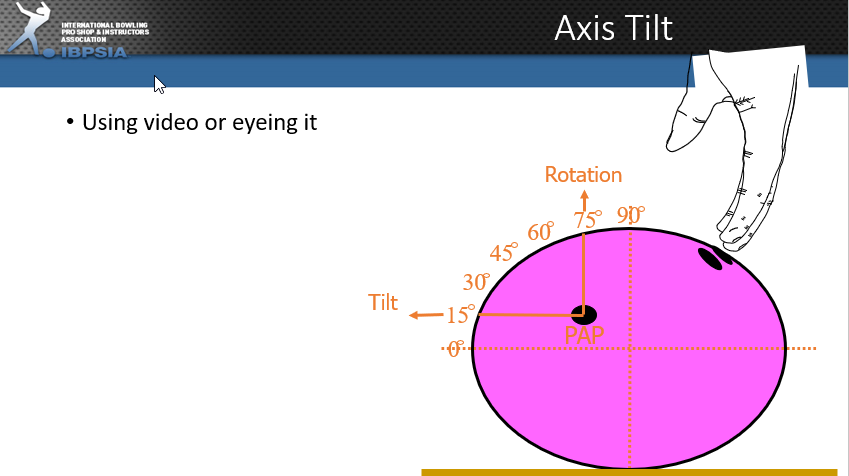
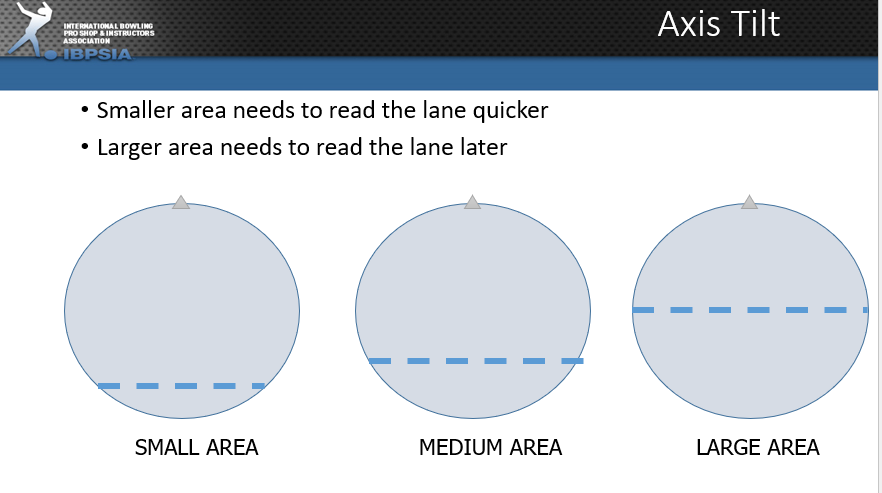
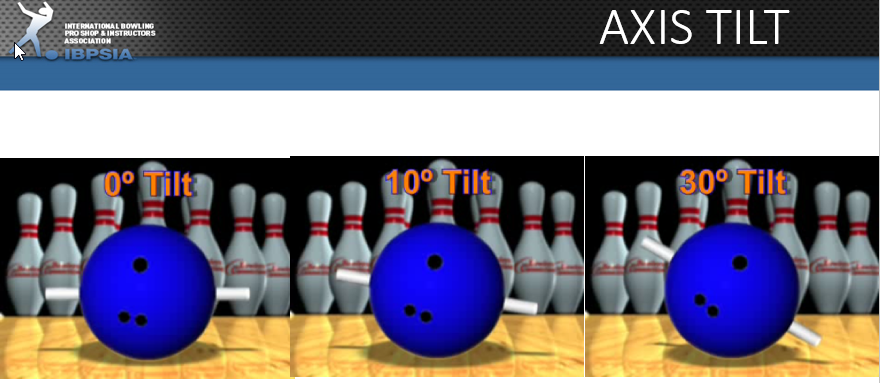
<div class="Gur8Ad" id="bkmrk--high-axis-tilt-%28-%3E4"><span data-huuid="14298330638564830174">**-High axis tilt** <span class="M5tQyf">**( &gt;40 °)**: <span data-huuid="14298330638564830939">The ball spins more like a top and rolls over a smaller portion of its circumference. </span><span data-huuid="14298330638564827608">This allows the ball to travel further down the lane before hooking sharply.<span class="pjBG2e" data-cid="cb8602a3-b0b5-40fb-ad80-db0fde4269b8"><span class="UV3uM"> </span></span></span></span></span><div class="CM8kHf j86kh" data-hveid="CBEQAQ" jsaction="rcuQ6b:npT2md;wSL7Ad:XJ9Oqb" jscontroller="ZQtivb"><div data-expression=">40^\circ" jsaction="rcuQ6b:npT2md" jscontroller="wErND"><div data-xpm-copy-root="" tabindex="-1">![](https://wiki.spectrebowling.com/uploads/images/gallery/2025-10/embedded-image-ekzisz6b.gif)</div><div data-xpm-copy-root="" tabindex="-1">**-Low axis tilt (&lt;7° )** :The ball rolls over more of its circumference, causing it to hook earlier in the lane and have a softer, more gradual reaction.<span class="pjBG2e" data-cid="2836aebf-f534-43bd-b050-6056d69d1816"><span class="UV3uM"> </span></span></div></div></div></div><div data-xpm-copy-root="" id="bkmrk-" tabindex="-1"></div><div data-xpm-copy-root="" id="bkmrk--medium-axis-tilt-%3A-" tabindex="-1">**<span class="pjBG2e" data-cid="2836aebf-f534-43bd-b050-6056d69d1816"><span class="UV3uM">-Medium axis tilt : </span></span>**<span class="pjBG2e" data-cid="2836aebf-f534-43bd-b050-6056d69d1816"><span class="UV3uM">This is often the desired range, providing a balance between length and a strong backend reaction.</span></span>**<span class="pjBG2e" data-cid="2836aebf-f534-43bd-b050-6056d69d1816"><span class="UV3uM"><span class="pjBG2e" data-cid="1c611299-3c5f-4909-9b57-7761288d530e"> </span></span></span>**</div><div data-xpm-copy-root="" id="bkmrk--1" tabindex="-1"></div><div data-xpm-copy-root="" id="bkmrk--2" tabindex="-1"></div><div data-xpm-copy-root="" id="bkmrk--the-same-procedure-" tabindex="-1">**<span class="pjBG2e" data-cid="2836aebf-f534-43bd-b050-6056d69d1816"><span class="UV3uM"><span class="pjBG2e" data-cid="1c611299-3c5f-4909-9b57-7761288d530e">-The same procedure applies — that is, placing a piece of tape on your PAP (Positive Axis Point).</span></span></span>**</div><div data-xpm-copy-root="" id="bkmrk-video-analysis%3A%C2%A0you-" tabindex="-1">- <span data-huuid="14298330638564829313">**Video analysis:** </span><span data-huuid="14298330638564830078">You can take a video of your release from a low angle and analyze it with special tools or by frame-by-frame analysis.<span class="pjBG2e" data-cid="c1b75473-48ac-4654-a205-e04e77fdf5ac"><span class="UV3uM"> </span></span></span>[![POWERPNT_jLZ4baQHN1.png](https://wiki.spectrebowling.com/uploads/images/gallery/2025-10/scaled-1680-/powerpnt-jlz4baqhn1.png)](https://wiki.spectrebowling.com/uploads/images/gallery/2025-10/powerpnt-jlz4baqhn1.png)
    
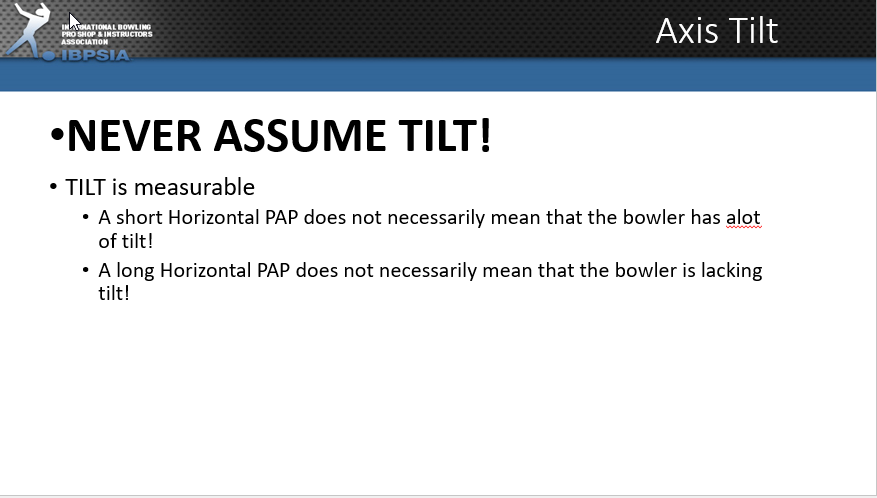
     NEVER assume the axis tilt. You need to draw the first oil line closest to your grip and follow it all the way around the ball. [![POWERPNT_GYrCXblqq6.png](https://wiki.spectrebowling.com/uploads/images/gallery/2025-10/scaled-1680-/powerpnt-gyrcxblqq6.png)](https://wiki.spectrebowling.com/uploads/images/gallery/2025-10/powerpnt-gyrcxblqq6.png)
- [![chrome_yv3fQcydsc.png](https://wiki.spectrebowling.com/uploads/images/gallery/2025-10/scaled-1680-/chrome-yv3fqcydsc.png)](https://wiki.spectrebowling.com/uploads/images/gallery/2025-10/chrome-yv3fqcydsc.png)
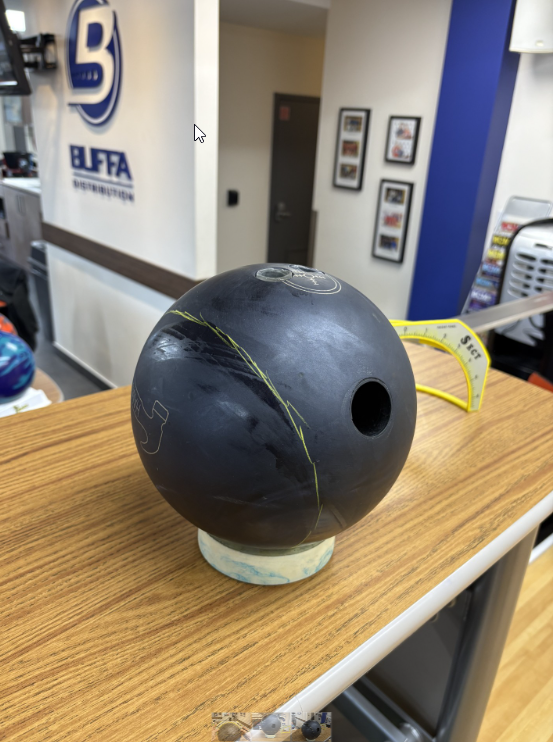
- *Then, turn the ball to ensure the yellow line you marked is parallel to the ground.*
    
    [![chrome_pXyC0cV3H4.png](https://wiki.spectrebowling.com/uploads/images/gallery/2025-10/scaled-1680-/chrome-pxyc0cv3h4.png)](https://wiki.spectrebowling.com/uploads/images/gallery/2025-10/chrome-pxyc0cv3h4.png)
    
    [![POWERPNT_AbX3WDI9si.png](https://wiki.spectrebowling.com/uploads/images/gallery/2025-10/scaled-1680-/powerpnt-abx3wdi9si.png)](https://wiki.spectrebowling.com/uploads/images/gallery/2025-10/powerpnt-abx3wdi9si.png)
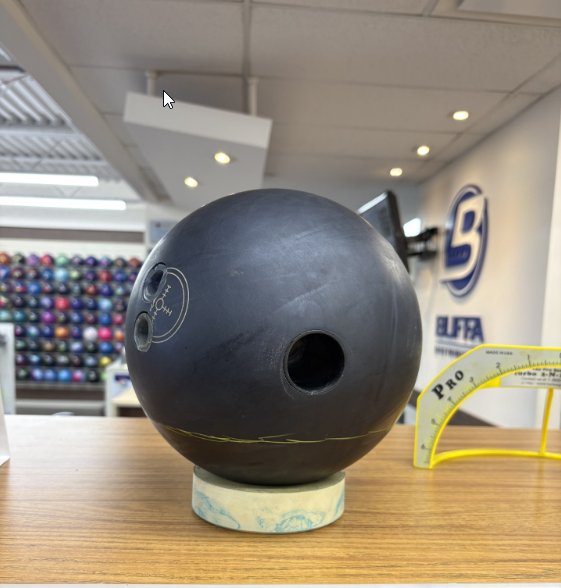
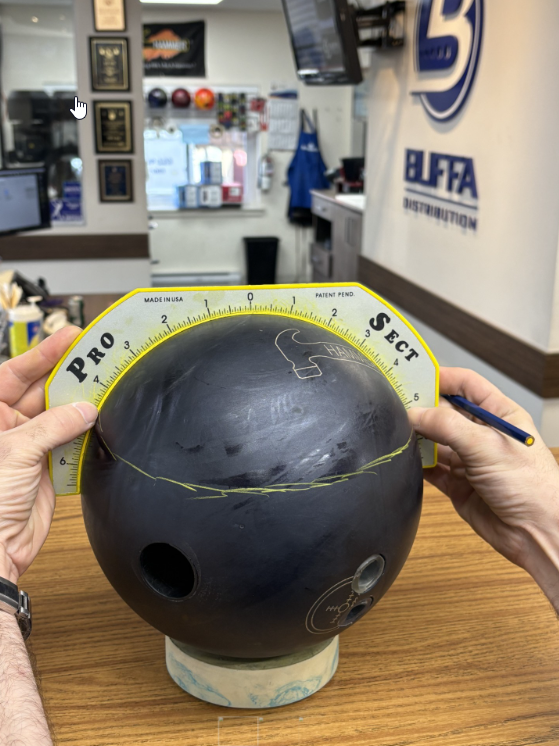
- To determine the tilt angle, flip the ball so that the circle is on top. Then, using the Prosect tool, align the 0 with the highest point on the ball and measure both sides where the lines connect. See the image below. The distance is in Inches !!! [![chrome_Xwvgp79KmM.png](https://wiki.spectrebowling.com/uploads/images/gallery/2025-10/scaled-1680-/chrome-xwvgp79kmm.png)](https://wiki.spectrebowling.com/uploads/images/gallery/2025-10/chrome-xwvgp79kmm.png)
- Using the chart, the distance you found will tell you your tilt angle. [![POWERPNT_F5C9Js5xRM.png](https://wiki.spectrebowling.com/uploads/images/gallery/2025-10/scaled-1680-/powerpnt-f5c9js5xrm.png)](https://wiki.spectrebowling.com/uploads/images/gallery/2025-10/powerpnt-f5c9js5xrm.png)
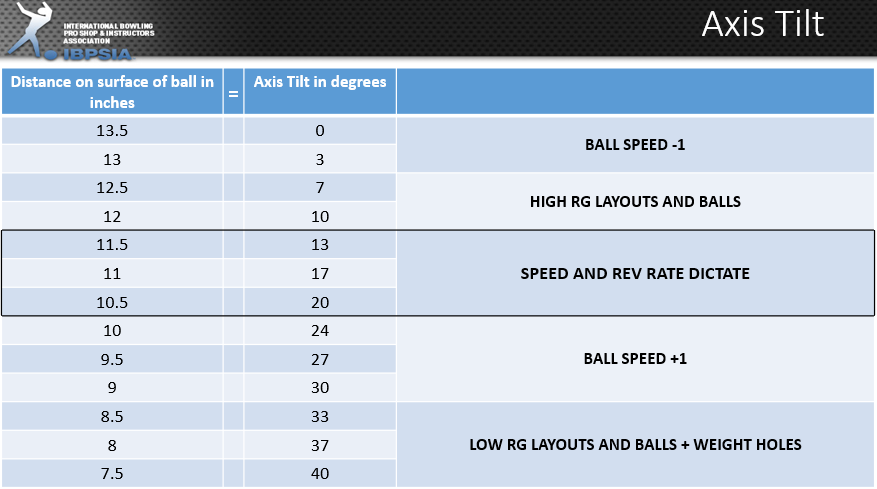
- In the example above, the distance is 10 inches, so the tilt is 24 degrees. [![POWERPNT_faICOhKRkn.png](https://wiki.spectrebowling.com/uploads/images/gallery/2025-10/scaled-1680-/powerpnt-faicohkrkn.png)](https://wiki.spectrebowling.com/uploads/images/gallery/2025-10/powerpnt-faicohkrkn.png)
</div>