# Understanding all properties, composite of the bowling ball.

## ? **Three Key Properties of a Bowling Ball**

### 1. **CG – Centre of Gravity**

- **Definition**: The CG marks the **balance point** of the ball's core. It’s usually indicated by a small dot or marking on the surface of the ball.
- **Function**:
    
    
    - Helps determine the **drilling layout**.
    - Affects how the ball transitions through the **skid**, **hook**, and **roll** phases.
    - **Closer to the grip**, the reaction will be smoother.
    - **Farther from the grip**, it can create more flare potential (depending on the layout).
    - <span style="text-decoration: underline; color: rgb(0, 0, 0);">With the new regulations regarding the balance hole, as well as today’s equipment, it has become less of an important factor than it used to be.</span>

---

### 2. **PIN**

- **Definition**: The PIN is the distance between the **top of the core** and the **CG**, shown as a small coloured dot on the ball.
- **Function**:
    
    
    - Affects the **flare potential** and **length** of the ball before it begins to hook.
    - A **shorter PIN (e.g. 1–2")** will create an **earlier hook**, more controlled motion.
    - A **longer PIN (e.g. 4–5")** will create more **length** and a **sharper backend reaction**.
- ### 3. **Mass Bias (MB)**
    
    
    - **Definition**: Present in asymmetrical balls, it's the point where the **core is imbalanced** — usually marked with a symbol (e.g., a line, dot, or "MB" logo).
    - **Function**:
        
        
        - Controls the **shape and sharpness of the hook**, especially in the **backend** phase.
        - Crucial for advanced layouts — especially in high-performance balls.
        - Placement of the Mass Bias affects **how quickly and how strongly the ball changes direction**.
        - [![POWERPNT_dm8VdKhjJW.png](https://wiki.spectrebowling.com/uploads/images/gallery/2025-10/scaled-1680-/powerpnt-dm8vdkhjjw.png)](https://wiki.spectrebowling.com/uploads/images/gallery/2025-10/powerpnt-dm8vdkhjjw.png)
        - [![POWERPNT_r84VipZEdI.png](https://wiki.spectrebowling.com/uploads/images/gallery/2025-10/scaled-1680-/powerpnt-r84vipzedi.png)](https://wiki.spectrebowling.com/uploads/images/gallery/2025-10/powerpnt-r84vipzedi.png)
            
            [![POWERPNT_hahor5kAUs.png](https://wiki.spectrebowling.com/uploads/images/gallery/2025-10/scaled-1680-/powerpnt-hahor5kaus.png)](https://wiki.spectrebowling.com/uploads/images/gallery/2025-10/powerpnt-hahor5kaus.png)
            
            <div aria-level="3" class="otQkpb" data-animation-nesting="" data-processed="true" data-sfc-cp="" jscontroller="a7qCn" jsuid="JxYMN_28" role="heading">**Key takeaway<span class="txxDge notranslate" data-processed="true" data-wiz-uids="JxYMN_29,JxYMN_2a"><span class="vKEkVd" data-animation-atomic="" data-processed="true"><button aria-label="View related links" class="rBl3me" data-amic="true" data-icl-uuid="6f297a63-1ddd-4ff0-8670-0f717967a5d0" data-processed="true" data-ved="2ahUKEwjr-uWitbCQAxXaj4kEHSquBuYQye0OegQICBAA" tabindex="0"><span class="wiMplc ofC0Ud" data-processed="true"><svg fill="currentColor" focusable="false" height="12px" viewbox="0 0 24 24" width="12px" xmlns="http://www.w3.org/2000/svg"><path d="M3.9 12c0-1.71 1.39-3.1 3.1-3.1h4V7H7c-2.76 0-5 2.24-5 5s2.24 5 5 5h4v-1.9H7c-1.71 0-3.1-1.39-3.1-3.1zM8 13h8v-2H8v2zm9-6h-4v1.9h4c1.71 0 3.1 1.39 3.1 3.1s-1.39 3.1-3.1 3.1h-4V17h4c2.76 0 5-2.24 5-5s-2.24-5-5-5z"></path></svg></span></button></span></span>**</div>
            - **<span class="T286Pc" data-processed="true" data-sfc-cp="">The "pin in or out" refers to the orientation of the weight block, while "top weight" is a ball characteristic used to achieve the desired layout.</span>**
            - **<span class="T286Pc" data-processed="true" data-sfc-cp="">The most important factor for performance is the layout, which is a combination of top weight, pin length, and mass bias location.</span><span class="uJ19be notranslate" data-processed="true" data-wiz-uids="JxYMN_2g,JxYMN_2h"><span class="vKEkVd" data-animation-atomic="" data-processed="true"> </span></span>**[![POWERPNT_J8qURsy2QA.png](https://wiki.spectrebowling.com/uploads/images/gallery/2025-10/scaled-1680-/powerpnt-j8qursy2qa.png)](https://wiki.spectrebowling.com/uploads/images/gallery/2025-10/powerpnt-j8qursy2qa.png)
                
                [![POWERPNT_oFmRoyNbv9.png](https://wiki.spectrebowling.com/uploads/images/gallery/2025-10/scaled-1680-/powerpnt-ofmroynbv9.png)](https://wiki.spectrebowling.com/uploads/images/gallery/2025-10/powerpnt-ofmroynbv9.png)
                
                <span style="color: rgb(0, 0, 0);">**What are the different factors that influence the reaction of your bowling ball?**</span>
            - 
            - [![POWERPNT_0E8hB6sc4B.png](https://wiki.spectrebowling.com/uploads/images/gallery/2025-10/scaled-1680-/powerpnt-0e8hb6sc4b.png)![POWERPNT_EpBlZ0QPeO.png](https://wiki.spectrebowling.com/uploads/images/gallery/2025-10/scaled-1680-/powerpnt-epblz0qpeo.png)](https://wiki.spectrebowling.com/uploads/images/gallery/2025-10/powerpnt-0e8hb6sc4b.png)
            - [![POWERPNT_oylxCqdC8I.png](https://wiki.spectrebowling.com/uploads/images/gallery/2025-10/scaled-1680-/powerpnt-oylxcqdc8i.png)](https://wiki.spectrebowling.com/uploads/images/gallery/2025-10/powerpnt-oylxcqdc8i.png)
            - [![POWERPNT_duJGxPwD2R.png](https://wiki.spectrebowling.com/uploads/images/gallery/2025-10/scaled-1680-/powerpnt-dujgxpwd2r.png)](https://wiki.spectrebowling.com/uploads/images/gallery/2025-10/powerpnt-dujgxpwd2r.png)
                
                [![POWERPNT_KufqFydRtg.png](https://wiki.spectrebowling.com/uploads/images/gallery/2025-10/scaled-1680-/powerpnt-kufqfydrtg.png)](https://wiki.spectrebowling.com/uploads/images/gallery/2025-10/powerpnt-kufqfydrtg.png)
            - <span style="text-decoration: underline;"><span style="color: rgb(0, 0, 0); text-decoration: underline;">Equipment Surface </span></span>
            - 
            - [![POWERPNT_brFtUiStj9.png](https://wiki.spectrebowling.com/uploads/images/gallery/2025-10/scaled-1680-/powerpnt-brftuistj9.png)](https://wiki.spectrebowling.com/uploads/images/gallery/2025-10/powerpnt-brftuistj9.png)
            - These 18 factors work **together** to determine how a bowling ball behaves during its three motion phases: **skid**, **hook**, and **roll**.
            - [![POWERPNT_ifTyw1NKMa.png](https://wiki.spectrebowling.com/uploads/images/gallery/2025-10/scaled-1680-/powerpnt-iftyw1nkma.png)](https://wiki.spectrebowling.com/uploads/images/gallery/2025-10/powerpnt-iftyw1nkma.png)
                
                <span style="text-decoration: underline;"><span style="color: rgb(0, 0, 0); text-decoration: underline;">Surface and chemical omposition of the ball :[![POWERPNT_q4zk0uta0Z.png](https://wiki.spectrebowling.com/uploads/images/gallery/2025-10/scaled-1680-/fe0powerpnt-q4zk0uta0z.png)](https://wiki.spectrebowling.com/uploads/images/gallery/2025-10/fe0powerpnt-q4zk0uta0z.png)</span></span>
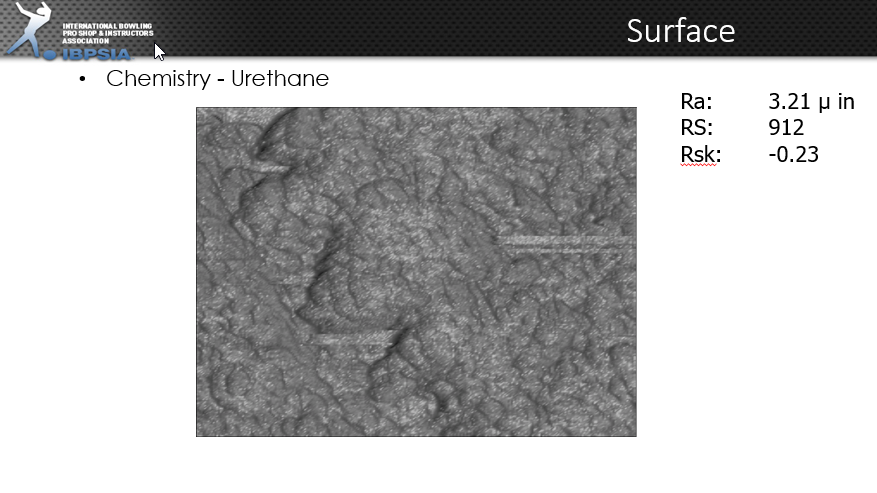
            - ## ? **Chemical Composition of Bowling Balls &amp; Hook Potential**
                
                Here’s a **comparison table** showing the **main chemical materials** used in each type of bowling ball coverstock and how much **hook potential** each one offers.
                
                ---
                
                ### ? **Comparison Chart – Chemical Composition vs. Hook Potential**
                
                <div class="_tableContainer_1rjym_1"><div class="group _tableWrapper_1rjym_13 flex w-fit flex-col-reverse" tabindex="-1"><table class="w-fit min-w-(--thread-content-width)" data-end="1554" data-start="459"><thead data-end="546" data-start="459"><tr data-end="546" data-start="459"><th data-col-size="sm" data-end="486" data-start="459">Ball Type</th><th data-col-size="md" data-end="514" data-start="486">Main Chemical Composition</th><th data-col-size="lg" data-end="528" data-start="514">Description</th><th data-col-size="sm" data-end="546" data-start="528">Hook Potential</th></tr></thead><tbody data-end="1554" data-start="635"><tr data-end="831" data-start="635"><td data-col-size="sm" data-end="662" data-start="635">**Plastic (Polyester)**</td><td data-col-size="md" data-end="719" data-start="662">**Polyester resin** (Polyethylene Terephthalate – PET)</td><td data-col-size="lg" data-end="816" data-start="719">Smooth, hard surface with very low friction. Commonly used for straight shots and spare balls.</td><td data-col-size="sm" data-end="831" data-start="816">? Very Low</td></tr><tr data-end="1057" data-start="832"><td data-col-size="sm" data-end="859" data-start="832">**Urethane**</td><td data-col-size="md" data-end="943" data-start="859">**Polyurethane** (Created by reacting polyols with diisocyanates like MDI or TDI)</td><td data-col-size="lg" data-end="1035" data-start="943">Slightly porous, offers more traction than plastic. Known for a smooth, controllable arc.</td><td data-col-size="sm" data-end="1057" data-start="1035">?? Low to Medium</td></tr><tr data-end="1332" data-start="1058"><td data-col-size="sm" data-end="1085" data-start="1058">**Reactive Resin**</td><td data-col-size="md" data-end="1189" data-start="1085">**Modified polyurethane** with reactive additives (plasticizers, curing agents, oil-absorbing resins)</td><td data-col-size="lg" data-end="1317" data-start="1189">High friction, porous surface that absorbs oil, creating a strong backend hook. Most popular for league and competitive play.</td><td data-col-size="sm" data-end="1332" data-start="1317">??? High</td></tr><tr data-end="1554" data-start="1333"><td data-col-size="sm" data-end="1360" data-start="1333">**Particle (Proactive)**</td><td data-col-size="md" data-end="1437" data-start="1360">**Reactive resin** infused with **microparticles** (ceramic, silica, etc.)</td><td data-col-size="lg" data-end="1532" data-start="1437">Roughest surface, maximum traction in heavy oil conditions. Used mainly by advanced players.</td><td data-col-size="sm" data-end="1554" data-start="1532">???? Very High</td></tr></tbody></table>
                
                </div></div>### ? **Hook Strength Ranking (from lowest to highest)**
                
                <div class="_tableContainer_1rjym_1"><div class="group _tableWrapper_1rjym_13 flex w-fit flex-col-reverse" tabindex="-1">
                1. ? **Plastic** – Minimal hook, best for straight throws or spare shooting
                2. ? **Urethane** – Moderate hook, offers control and predictability
                3. ? **Reactive Resin** – Strong hook, great backend motion
                4. ⚫ **Particle** – Maximum hook, ideal for heavy oil patterns (less common now)
                5. ## ? **Key Properties of Polyurethane (Urethane) in Bowling Balls**
                    
                    <div class="_tableContainer_1rjym_1"><div class="group _tableWrapper_1rjym_13 flex w-fit flex-col-reverse" tabindex="-1"><table class="w-fit min-w-(--thread-content-width)" data-end="1641" data-start="1063"><thead data-end="1116" data-start="1063"><tr data-end="1116" data-start="1063"><th data-col-size="sm" data-end="1074" data-start="1063">Property</th><th data-col-size="md" data-end="1091" data-start="1074">Chemical Basis</th><th data-col-size="md" data-end="1116" data-start="1091">Effect on Performance</th></tr></thead><tbody data-end="1641" data-start="1172"><tr data-end="1317" data-start="1172"><td data-col-size="sm" data-end="1189" data-start="1172">**Durability**</td><td data-col-size="md" data-end="1271" data-start="1189">Strong carbon–nitrogen (C–N) and carbon–oxygen (C–O) bonds in urethane linkages</td><td data-col-size="md" data-end="1317" data-start="1271">Resists cracking and chipping under impact</td></tr><tr data-end="1416" data-start="1318"><td data-col-size="sm" data-end="1343" data-start="1318">**Low Oil Absorption**</td><td data-col-size="md" data-end="1380" data-start="1343">Tight cross-linked polymer network</td><td data-col-size="md" data-end="1416" data-start="1380">Predictable motion on oily lanes</td></tr><tr data-end="1525" data-start="1417"><td data-col-size="sm" data-end="1441" data-start="1417">**Moderate Friction**</td><td data-col-size="md" data-end="1475" data-start="1441">Less porous than reactive resin</td><td data-col-size="md" data-end="1525" data-start="1475">Smooth, controllable hook (not too aggressive)</td></tr><tr data-end="1641" data-start="1526"><td data-col-size="sm" data-end="1541" data-start="1526">**Hardness**</td><td data-col-size="md" data-end="1582" data-start="1541">Controlled by polymer blend and curing</td><td data-col-size="md" data-end="1641" data-start="1582">Durometer typically 74–78D (harder than reactive resin)</td></tr></tbody></table>
                    
                    </div></div>[![POWERPNT_SR475DFwKL.png](https://wiki.spectrebowling.com/uploads/images/gallery/2025-10/scaled-1680-/powerpnt-sr475dfwkl.png)](https://wiki.spectrebowling.com/uploads/images/gallery/2025-10/powerpnt-sr475dfwkl.png)
                    
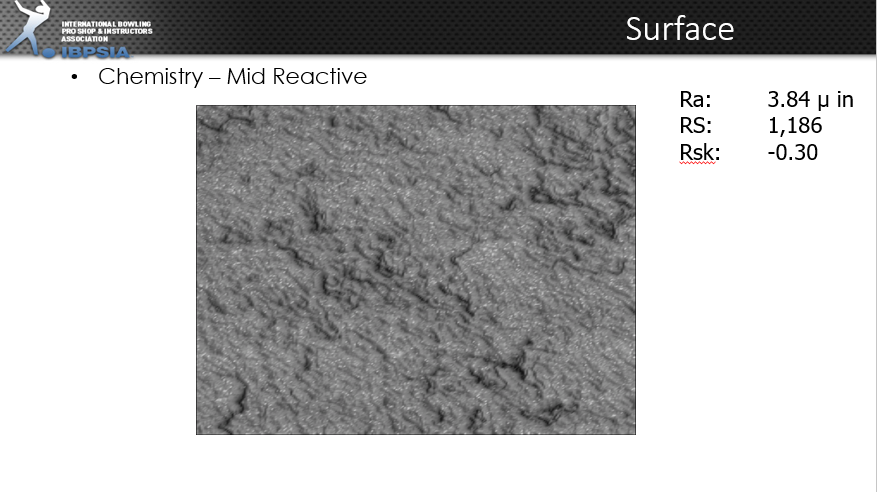
                    ## ? Chemistry of Mid-Reactive Bowling Balls
                    
                    ### What Is a Mid-Reactive Bowling Ball?
                    
                    
                    - A **mid-reactive bowling ball** has a coverstock chemically designed to provide **moderate friction and oil absorption** on the lane.
                    - It’s engineered to perform between **low-reactive** (slicker, less hook) and **high-reactive** (more aggressive hook) balls.
                    
                    ---
                    
                    ### Chemical Composition
                    
                    
                    1. **Base Polymer: Polyurethane Resin**
                        
                        
                        - The core polymer is **polyurethane**, created by reacting **polyols** (compounds with multiple hydroxyl groups, –OH) and **diisocyanates** (usually MDI or TDI).
                        - This reaction forms **urethane linkages (–NH–CO–O–)** resulting in a durable, cross-linked thermoset polymer.
                    2. **Reactive Additives**
                        
                        
                        - Mid-reactive balls contain **moderate amounts of reactive resins and plasticizers**.
                        - These additives increase the **porosity** and **oil absorption** of the coverstock but to a lesser degree than high-reactive balls.
                        - This balanced chemical mix creates enough surface “grip” for good traction without over-reacting.
                    3. **Surface Finish / Texture**
                        
                        
                        - Chemically and physically, the surface has a **medium level of micro-roughness** (often achieved by sanding or polishing).
                        - This finish exposes the coverstock’s reactive pores to the lane oil just enough to produce a **controlled hook**.
                    
                    [![POWERPNT_SN3cbDusR6.png](https://wiki.spectrebowling.com/uploads/images/gallery/2025-10/scaled-1680-/powerpnt-sn3cbdusr6.png)](https://wiki.spectrebowling.com/uploads/images/gallery/2025-10/powerpnt-sn3cbdusr6.png)
                    
                    ## ? Chemistry of High-Reactive Bowling Balls
                    
                    ### What Does “High-Reactive” Mean?
                    
                    
                    - **High-reactive bowling balls** have coverstocks formulated to maximize **friction and oil absorption**.
                    - They create a strong **hook motion**, especially on medium to heavy oil lane conditions.
                    - This is achieved through specific chemical and physical properties of the coverstock.
                    
                    ---
                    
                    ### Chemical Composition
                    
                    
                    1. **Base Polymer: Polyurethane Resin**
                        
                        
                        - Like other reactive balls, the base polymer is **polyurethane**, synthesized by reacting **polyols** with **diisocyanates** (MDI or TDI).
                        - This creates a **cross-linked thermoset polymer** providing durability and elasticity.
                    2. **Reactive Resin Additives**
                        
                        
                        - High-reactive balls contain **higher concentrations of reactive additives and plasticizers** compared to mid- or low-reactive balls.
                        - These include **specialized resin compounds** that increase the **porosity** of the coverstock and its **ability to absorb lane oil**.
                    3. **Surface Microstructure**
                        
                        
                        - The coverstock surface is chemically engineered to have a **highly porous microstructure**.
                        - This allows the ball to absorb more oil, increasing friction once it reaches the dry backend portion of the lane, resulting in a stronger hook.
                            
                            [![POWERPNT_kfpml3Xd2Y.png](https://wiki.spectrebowling.com/uploads/images/gallery/2025-10/scaled-1680-/powerpnt-kfpml3xd2y.png)](https://wiki.spectrebowling.com/uploads/images/gallery/2025-10/powerpnt-kfpml3xd2y.png)
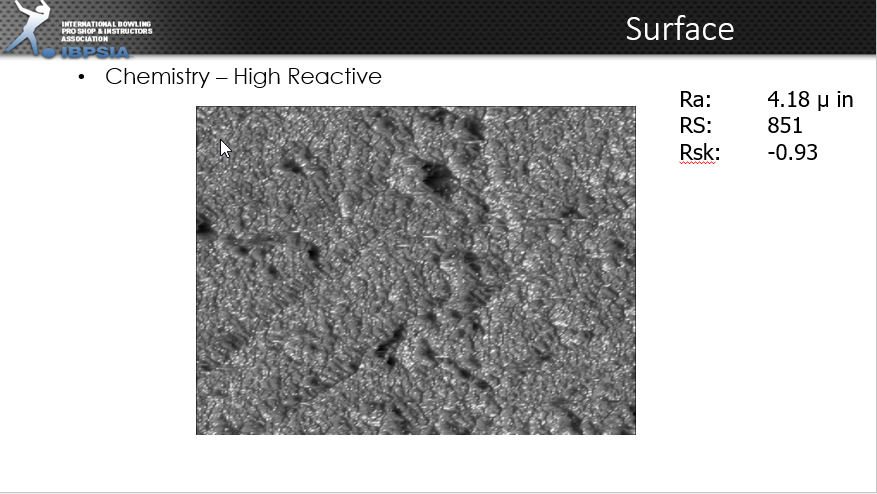
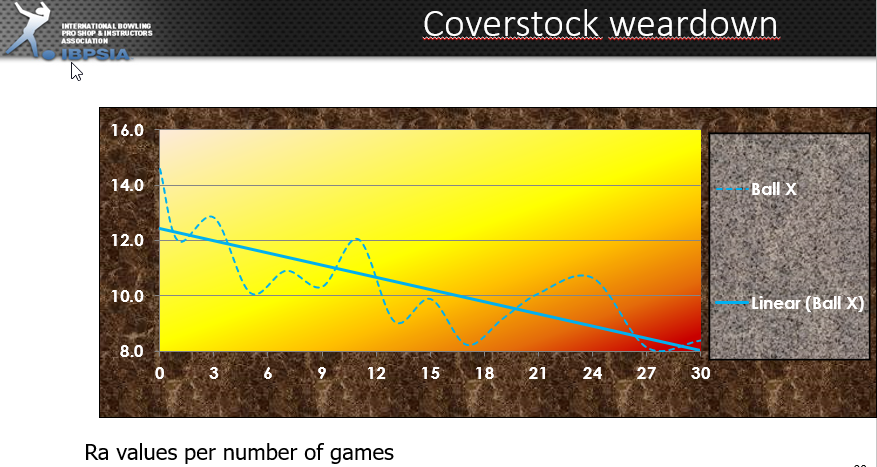
                        - ## ? Coverstock Wear-Down on Bowling Balls
                            
                            ### What is Coverstock Wear-Down?
                            
                            
                            - **Coverstock wear-down** refers to the gradual **erosion, abrasion, or smoothing** of the bowling ball’s outer shell (coverstock) surface after repeated use.
                            - Over time, the coverstock loses its original texture, surface finish, and chemical properties that help it grip the lane.
                            
                            ---
                            
                            ### Why Does Coverstock Wear Down?
                            
                            
                            1. **Friction with Lane Surface**
                                
                                
                                - Constant contact with the lane, especially on abrasive synthetic or wood lanes, causes microscopic scratches and smooths rough surfaces.
                            2. **Cleaning &amp; Maintenance**
                                
                                
                                - Repeated cleaning with harsh chemicals or improper maintenance can degrade the surface.
                            3. **Impact with Pins and Gutter**
                                
                                
                                - Hitting pins hard or rolling into gutters can cause chips, scratches, and dents.
                            4. **Heat &amp; Chemical Changes**
                                
                                
                                - Heat generated by friction and chemical reactions with lane oils or cleaners can alter the polymer structure over time.
                            
                            ---
                            
                            ### How Does Wear-Down Affect Ball Performance?
                            
                            <div class="_tableContainer_1rjym_1"><div class="group _tableWrapper_1rjym_13 flex w-fit flex-col-reverse" tabindex="-1"><table class="w-fit min-w-(--thread-content-width)" data-end="1683" data-start="1199"><thead data-end="1271" data-start="1199"><tr data-end="1271" data-start="1199"><th data-col-size="sm" data-end="1229" data-start="1199">Effect</th><th data-col-size="md" data-end="1271" data-start="1229">Impact on Ball Reaction</th></tr></thead><tbody data-end="1683" data-start="1343"><tr data-end="1425" data-start="1343"><td data-col-size="sm" data-end="1373" data-start="1343">**Loss of Surface Texture**</td><td data-col-size="md" data-end="1425" data-start="1373">Reduced friction with lane → less hook potential</td></tr><tr data-end="1505" data-start="1426"><td data-col-size="sm" data-end="1456" data-start="1426">**Smoother Surface**</td><td data-col-size="md" data-end="1505" data-start="1456">More skid → ball slides longer before hooking</td></tr><tr data-end="1603" data-start="1506"><td data-col-size="sm" data-end="1536" data-start="1506">**Decreased Porosity**</td><td data-col-size="md" data-end="1603" data-start="1536">Less oil absorption in reactive balls → weaker backend reaction</td></tr><tr data-end="1683" data-start="1604"><td data-col-size="sm" data-end="1634" data-start="1604">**Cracks or Chips**</td><td data-col-size="md" data-end="1683" data-start="1634">Inconsistent ball roll, potential ball damage</td></tr></tbody></table>
                            
                            </div></div>---
                            
                            ### Signs You May Need to Resurface or Replace Coverstock
                            
                            
                            - Noticeably **less hook** despite similar lane conditions
                            - Visible **shiny or slick patches** on the ball surface
                            - **Chips or deep scratches** that affect ball roll
                            - Ball feels “dead” or **doesn’t respond** like it used to
                            
                            ---
                            
                            ### Maintenance Tips to Minimize Wear-Down
                            
                            
                            - **Regular cleaning** with proper bowling ball cleaners after each session
                            - **Avoid harsh chemicals** that damage the polymer
                            - **Periodic resurfacing or polishing** by a pro shop to restore texture
                            - **Use multiple balls** to spread out wear on different coverstocks
                            -
                        - [![POWERPNT_91mBn7CU3G.png](https://wiki.spectrebowling.com/uploads/images/gallery/2025-10/scaled-1680-/Vs5powerpnt-91mbn7cu3g.png)](https://wiki.spectrebowling.com/uploads/images/gallery/2025-10/Vs5powerpnt-91mbn7cu3g.png)
                            
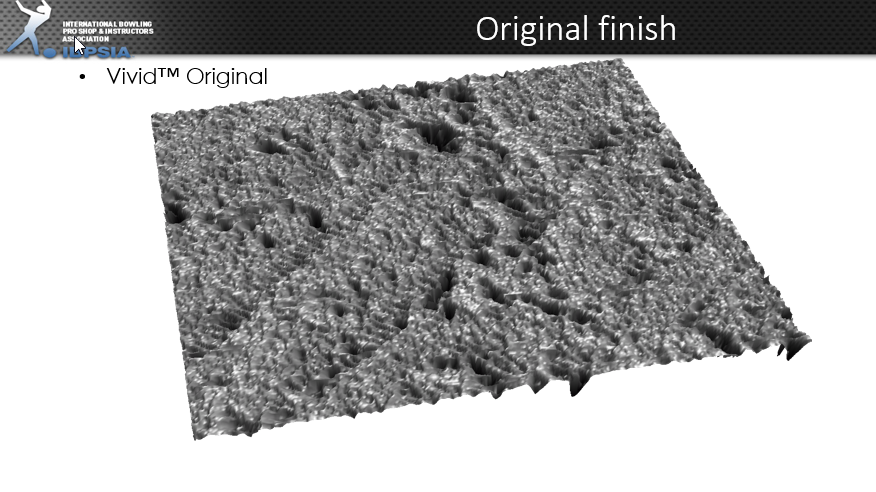
                            [![POWERPNT_OGnypFxrwu.png](https://wiki.spectrebowling.com/uploads/images/gallery/2025-10/scaled-1680-/powerpnt-ognypfxrwu.png)](https://wiki.spectrebowling.com/uploads/images/gallery/2025-10/powerpnt-ognypfxrwu.png)
                            
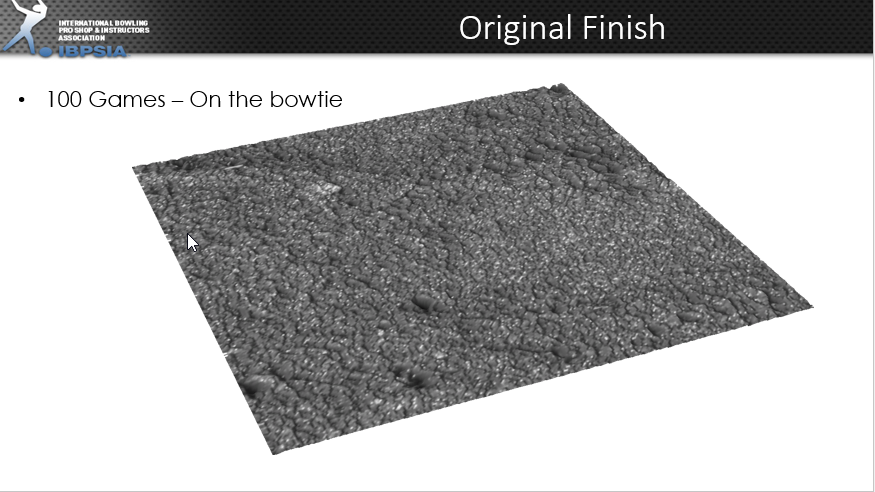
                            [![POWERPNT_sMO5Chzrxf.png](https://wiki.spectrebowling.com/uploads/images/gallery/2025-10/scaled-1680-/powerpnt-smo5chzrxf.png)](https://wiki.spectrebowling.com/uploads/images/gallery/2025-10/powerpnt-smo5chzrxf.png)
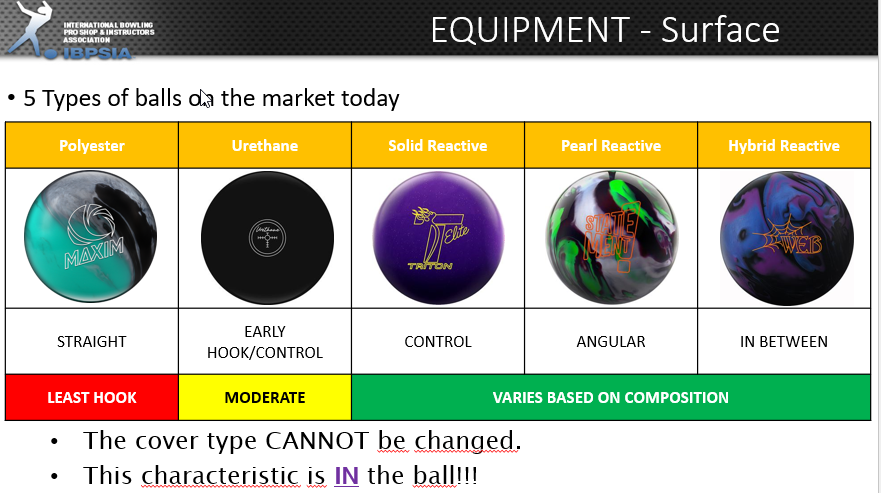
                        - <span style="text-decoration: underline;">Here the all 5 type of characteristic of bowling ball in the market :</span>
                        - ## 1. Plastic / Polyester Coverstock
                            
                            **What it is &amp; when to use it:**
                            
                            
                            - Smooth, low‑friction surface, so minimal hook.
                            - Great for beginners, straight shots, or spare‑balls because it goes fairly straight and predictably.
                            - Less suited for heavy hook or oily lane conditions.
                            
                            ---
                            
                            ## 2. Urethane Coverstock
                            
                            **What it is &amp; when to use it:**
                            
                            
                            - More friction than plastic, so it gives you more hook potential while still being controllable.
                            - Often a good transition ball for bowlers moving from straight shots toward more hooking style.
                            - Works well on lanes with **medium to dry oil** conditions.
                            
                            ---
                            
                            ## 3. Reactive Resin Coverstock
                            
                            **What it is &amp; when to use it:**
                            
                            
                            - Covers a big performance space: made of porous resin, absorbs some oil, and offers substantial hooking power.
                            - There are sub‑types: **Solid Reactive**, **Pearl Reactive**, **Hybrid Reactive** (mix of solid+pearl) — each with different behaviour.
                            - Best for bowlers who are more experienced and/or lanes have **medium to heavy oil**.
                            - The difference:
                                
                                
                                - *Solid* = stronger hook = earlier (good for heavier oil).
                                - *Pearl* = more length then sharper backend.
                                - *Hybrid* = somewhere in between, good versatility.
                            
                            [![POWERPNT_M1wJVSIABV.png](https://wiki.spectrebowling.com/uploads/images/gallery/2025-10/scaled-1680-/pwDpowerpnt-m1wjvsiabv.png)](https://wiki.spectrebowling.com/uploads/images/gallery/2025-10/pwDpowerpnt-m1wjvsiabv.png)
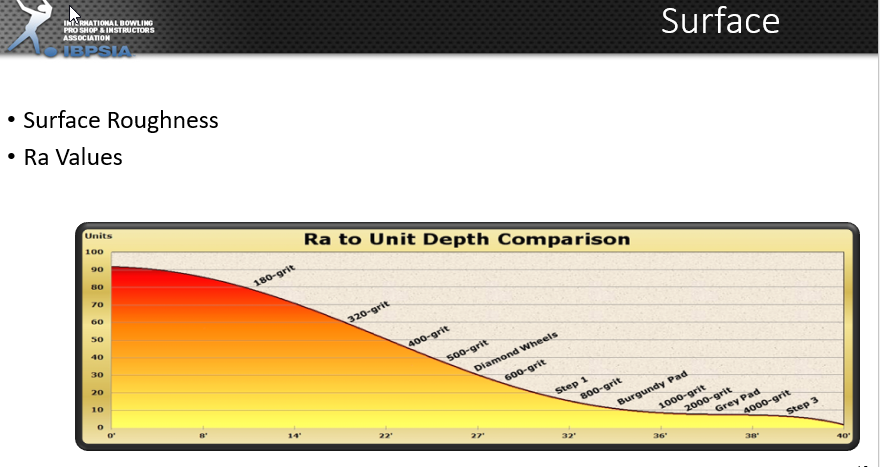
                        - ## What is surface roughness?
                            
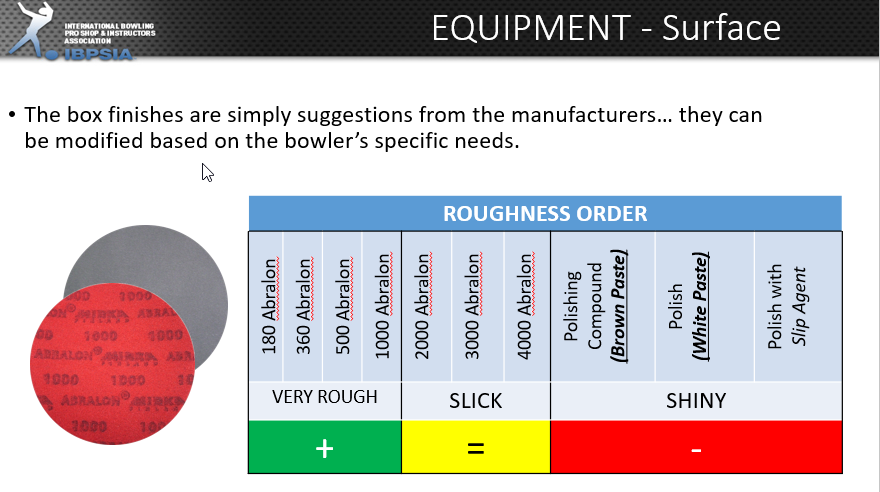
                            Surface roughness refers to the microscopic peaks and valleys (texture) on a ball’s coverstock. Two common metrics:
                            
                            
                            - **Ra** = the average height of peaks/valleys.
                            - **Rs** = the spacing/distribution of peaks and valleys.
                            
                            According to the United States Bowling Congress (USBC) Equipment Specification, the surface roughness Ra of a certified bowling ball **must not exceed 65 μin (micro‑inches)**, and the average across a weight class cannot exceed 50 μin.
                            
                            One study found reactive coverstock balls had about **1.5×** the roughness (measured as “Sa”) of polyester balls.
                            
                            So, roughness is a real measurable property and has been shown to be a key factor in how the ball behaves.
                            
                            ## Why surface roughness matters: performance effects
                            
                            Here are the major performance effects of altering surface roughness:
                            
                            ### Rougher surface (more texture)
                            
                            
                            - Increases friction between the ball cover and the lane surface, especially in the oil front end.
                            - Means the ball tends to **hook earlier** (i.e., it begins its transition from skid to hook sooner) because it “grips” the oil/wood sooner<span class="" data-state="closed"><span class="ms-1 inline-flex max-w-full items-center relative top-[-0.094rem] animate-[show_150ms_ease-in]" data-testid="webpage-citation-pill">[ ](https://www.stormbowling.com/optimizing-bowling-ball-surfaces?utm_source=chatgpt.com)</span></span>
                            - Best suited for heavier oil conditions (where you need the ball to read the lane sooner).
                            
                            ### Smoother surface (less texture)
                            
                            
                            - Less friction up front; the ball will tend to **skid farther before hooking**.
                            - The hook will be delayed (later breakpoint) and often sharper down‑lane (depending on cover).
                            - Best when lanes are drier, or you want more skid and backend roll rather than early hooking.
                            
                            ### Lifecycle and maintenance
                            
                            
                            - Over time and use, the ball’s surface can become smoother (due to lane machine contact, ball returns, oil absorption) and thus lose “grip” / hooking potential.
                            - Oil absorption in the cover pores also affects performance — once the pores fill, the ball doesn’t grip as well.
                                
                                ## Comparison table: surface finishes and their effects
                                
                                Here’s a quick comparison of how different finishes (grit levels / polish states) tend to behave. These are general guidelines (actual result will depend on coverstock chemistry, core, layout, lane conditions).
                                
                                <div class="_tableContainer_1rjym_1"><div class="group _tableWrapper_1rjym_13 flex w-fit flex-col-reverse" tabindex="-1"><table class="w-fit min-w-(--thread-content-width)" data-end="3726" data-start="2819"><thead data-end="2970" data-start="2819"><tr data-end="2970" data-start="2819"><th data-col-size="sm" data-end="2850" data-start="2819">Finish / Roughness Level</th><th data-col-size="sm" data-end="2890" data-start="2850">Typical Grit / Treatment</th><th data-col-size="md" data-end="2936" data-start="2890">Effect on Lane</th><th data-col-size="sm" data-end="2970" data-start="2936">Ideal For</th></tr></thead><tbody data-end="3726" data-start="3122"><tr data-end="3273" data-start="3122"><td data-col-size="sm" data-end="3152" data-start="3122">**Very Rough**</td><td data-col-size="sm" data-end="3192" data-start="3152">500–800 grit sanding (or equivalent)</td><td data-col-size="md" data-end="3239" data-start="3192">Highest friction → earliest hook → less skid</td><td data-col-size="sm" data-end="3273" data-start="3239">Heavy oil patterns</td></tr><tr data-end="3424" data-start="3274"><td data-col-size="sm" data-end="3304" data-start="3274">**Medium Rough / Sanded**</td><td data-col-size="sm" data-end="3344" data-start="3304">~1000–2000 grit</td><td data-col-size="md" data-end="3390" data-start="3344">Balanced friction/skid → medium hook</td><td data-col-size="sm" data-end="3424" data-start="3390">Medium oil or mixed conditions</td></tr><tr data-end="3575" data-start="3425"><td data-col-size="sm" data-end="3455" data-start="3425">**Smooth / Polished**</td><td data-col-size="sm" data-end="3495" data-start="3455">3000–5000 grit or mirror polish</td><td data-col-size="md" data-end="3541" data-start="3495">Lower friction → more skid → delayed hook</td><td data-col-size="sm" data-end="3575" data-start="3541">Dry lanes, when you want skid</td></tr><tr data-end="3726" data-start="3576"><td data-col-size="sm" data-end="3606" data-start="3576">**Very Smooth / High Gloss**</td><td data-col-size="sm" data-end="3646" data-start="3606">Dragon polish, factory gloss + polish</td><td data-col-size="md" data-end="3692" data-start="3646">Minimal front end friction → long skid</td><td data-col-size="sm" data-end="3726" data-start="3692">Dry lanes, spare ball, control</td></tr></tbody></table>
                                
                                </div></div>[![POWERPNT_4lF4vfjWHx.png](https://wiki.spectrebowling.com/uploads/images/gallery/2025-10/scaled-1680-/powerpnt-4lf4vfjwhx.png)](https://wiki.spectrebowling.com/uploads/images/gallery/2025-10/powerpnt-4lf4vfjwhx.png)
                                
                                [![POWERPNT_PlVnPfpQeR.png](https://wiki.spectrebowling.com/uploads/images/gallery/2025-10/scaled-1680-/powerpnt-plvnpfpqer.png)](https://wiki.spectrebowling.com/uploads/images/gallery/2025-10/powerpnt-plvnpfpqer.png)
                                
                                ## What is RG in Bowling?
                                
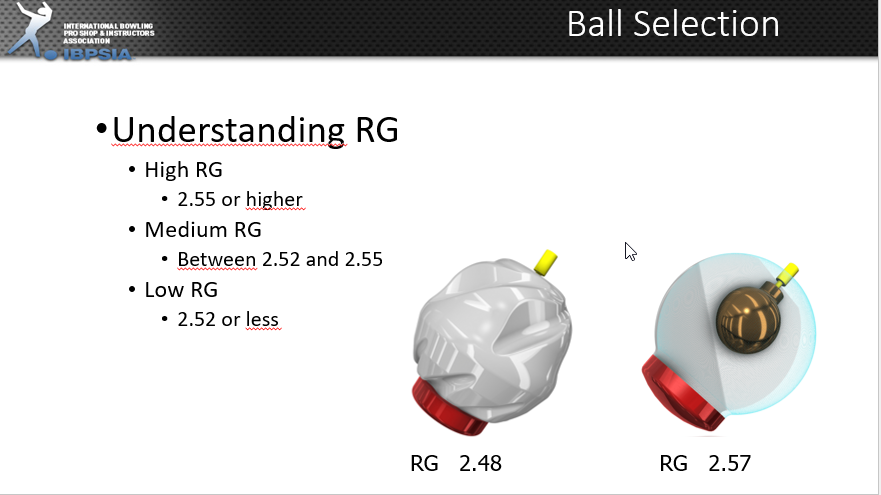
                                **RG (Radius of Gyration)** is a measurement that describes **how the mass inside a bowling ball is distributed**.
                                
                                
                                - It’s **not about weight**, but **how that weight is positioned** relative to the center of the ball.
                                - The number (typically between **2.46 and 2.80 inches**) gives insight into how soon the ball starts to rotate when it rolls down the lane.
                                
                                Think of it like a figure skater:
                                
                                
                                - Arms tucked in = spins faster (like a **low RG** ball).
                                - Arms extended = slower spin (like a **high RG** ball).
                                
                                ---
                                
                                ## ? RG Number Ranges and What They Mean
                                
                                <div class="_tableContainer_1rjym_1"><div class="group _tableWrapper_1rjym_13 flex w-fit flex-col-reverse" tabindex="-1"><table class="w-fit min-w-(--thread-content-width)" data-end="1392" data-start="804"><thead data-end="914" data-start="804"><tr data-end="914" data-start="804"><th data-col-size="sm" data-end="822" data-start="804">RG Range</th><th data-col-size="sm" data-end="842" data-start="822">Hook Timing</th><th data-col-size="sm" data-end="873" data-start="842">Reaction Style</th><th data-col-size="sm" data-end="914" data-start="873">Ideal Use</th></tr></thead><tbody data-end="1392" data-start="1025"><tr data-end="1147" data-start="1025"><td data-col-size="sm" data-end="1051" data-start="1025">**Low RG** (2.46–2.50)</td><td data-col-size="sm" data-end="1075" data-start="1051">**Early** roll</td><td data-col-size="sm" data-end="1106" data-start="1075">Reads lane early, smooth arc</td><td data-col-size="sm" data-end="1147" data-start="1106">Heavy oil, early hook needed</td></tr><tr data-end="1269" data-start="1148"><td data-col-size="sm" data-end="1174" data-start="1148">**Mid RG** (2.52–2.55)</td><td data-col-size="sm" data-end="1197" data-start="1174">Balanced timing</td><td data-col-size="sm" data-end="1228" data-start="1197">Controlled motion, versatile</td><td data-col-size="sm" data-end="1269" data-start="1228">Medium oil, all-around conditions</td></tr><tr data-end="1392" data-start="1270"><td data-col-size="sm" data-end="1296" data-start="1270">**High RG** (2.55 to 2.80)</td><td data-col-size="sm" data-end="1320" data-start="1296">**Late** roll</td><td data-col-size="sm" data-end="1351" data-start="1320">Longer skid, sharp backend</td><td data-col-size="sm" data-end="1392" data-start="1351">Dry lanes, late hook, backend angle</td></tr></tbody></table>
                                
                                </div></div>## ✅ What is RG?
                                
                                <div class="_tableContainer_1rjym_1"><div class="group _tableWrapper_1rjym_13 flex w-fit flex-col-reverse" tabindex="-1">
                                - RG measures how far from the axis of rotation the ball’s mass is (effectively) concentrated.
                                - In bowling-ball terms, a lower RG means mass is more toward the **center** of the ball; a higher RG means more mass is toward the **coverstock/surface**.
                                - The governing body United States Bowling Congress (USBC) defines RG values for certified balls in the range of approximately **2.460″ to 2.800″**.
                                - In simple analogy: imagine a figure skater. When their arms are pulled in (mass closer to centre) they spin faster — that’s like a lower RG. When their arms are extended (mass farther out) they rotate slower — that’s like a higher RG.
                                
                                ---
                                
                                </div></div>## ? How RG affects ball reaction
                                
                                Here’s how RG influences the motion of the ball on the lane:
                                
                                <div class="_tableContainer_1rjym_1"><div class="group _tableWrapper_1rjym_13 flex w-fit flex-col-reverse" tabindex="-1">
                                - **Low RG ball**: Mass is more central, so the ball will **rev up earlier**, meaning it will start hooking sooner. Good for heavy oil conditions where you want the ball to engage friction earlier.
                                - **Medium RG ball**: Balanced; picks up its hook mid-lane. Good all-rounder for many conditions.
                                - **High RG ball**: Mass is farther out, so the ball will **skid longer** before hooking, conserving energy for the back end of the lane. Good for drier lanes where you need the ball to go further before turning.
                                
                                ---
                                
                                </div></div>## ? RG Ranges &amp; What They Imply
                                
                                Here are some typical ranges and what they usually mean:
                                
                                <div class="_tableContainer_1rjym_1"><div class="group _tableWrapper_1rjym_13 flex w-fit flex-col-reverse" tabindex="-1"><div class="_tableContainer_1rjym_1"><div class="group _tableWrapper_1rjym_13 flex w-fit flex-col-reverse" tabindex="-1"><table class="w-fit min-w-(--thread-content-width)" data-end="2461" data-start="1996"><thead data-end="2035" data-start="1996"><tr data-end="2035" data-start="1996"><th data-col-size="sm" data-end="2007" data-start="1996">RG Range</th><th data-col-size="sm" data-end="2023" data-start="2007">Ball Behavior</th><th data-col-size="md" data-end="2035" data-start="2023">Best For</th></tr></thead><tbody data-end="2461" data-start="2077"><tr data-end="2203" data-start="2077"><td data-col-size="sm" data-end="2099" data-start="2077">2.52 or less</td><td data-col-size="sm" data-end="2128" data-start="2099">Low RG → earlier roll/hook</td><td data-col-size="md" data-end="2203" data-start="2128">Heavier oil, needing early motion </td></tr><tr data-end="2323" data-start="2204"><td data-col-size="sm" data-end="2226" data-start="2204">between 2.52-2.55</td><td data-col-size="sm" data-end="2261" data-start="2226">Medium RG → moderate skid + roll</td><td data-col-size="md" data-end="2323" data-start="2261">Versatile conditions </td></tr><tr data-end="2461" data-start="2324"><td data-col-size="sm" data-end="2346" data-start="2324">2.55 or higher</td><td data-col-size="sm" data-end="2382" data-start="2346">High RG → longer skid, later hook</td><td data-col-size="md" data-end="2461" data-start="2382">Dry lanes, need more backend action </td></tr></tbody></table>
                                
                                </div></div></div></div>Also note: RG is only one of the specs — “differential” (difference between max RG and min RG in various axes) influences **flare potential** (how much the ball rolls and transitions) which also matters a lot.
                                
                                <div class="_tableContainer_1rjym_1"><div class="group _tableWrapper_1rjym_13 flex w-fit flex-col-reverse" tabindex="-1">---
                                
                                </div></div>## ? How to Use RG When Selecting a Ball
                                
                                When you’re selecting a ball, consider these steps:
                                
                                <div class="_tableContainer_1rjym_1"><div class="group _tableWrapper_1rjym_13 flex w-fit flex-col-reverse" tabindex="-1">
                                1. **Check lane conditions**: Are they oily? Dry? Medium?
                                2. **Match RG to lane**:
                                    
                                    
                                    - Oily: consider lower RG (to engage earlier)
                                    - Dry: consider higher RG (so the ball doesn’t hook too early)
                                3. **Consider your style**: Speed, rev rate, finger/hand release all matter. If you generate a lot of revs, you might want a higher RG to delay the roll. If you’re lower revs, a lower RG might help engage earlier.
                                4. **Coverstock + core + drilling layout**: RG is part of the story, but surface (coverstock) and drilling/layout also heavily affect how the ball performs.
                                5. **Check Differential**: A ball with low RG but very high differential might hook very aggressively—may be too much for certain lane/dryer conditions.
                                    
                                    [![POWERPNT_DWLhR1RvTW.png](https://wiki.spectrebowling.com/uploads/images/gallery/2025-10/scaled-1680-/powerpnt-dwlhr1rvtw.png)](https://wiki.spectrebowling.com/uploads/images/gallery/2025-10/powerpnt-dwlhr1rvtw.png)
                                    
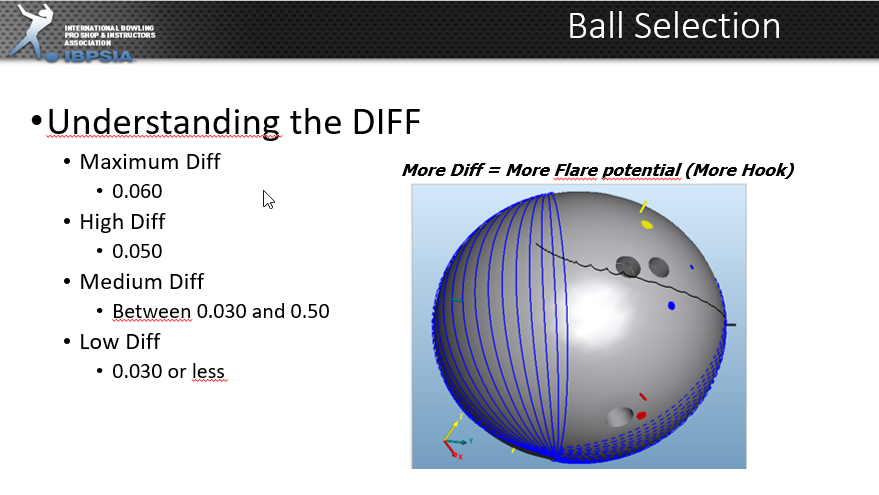
                                    ## ? What Is Differential?
                                    
                                    **Differential** measures **the difference between a bowling ball’s maximum and minimum RG values** — essentially, how unevenly the weight is distributed inside the ball.
                                    
                                    
                                    - **High differential** = greater difference between axes of rotation → the ball flares more and hooks harder.
                                    - **Low differential** = smaller difference → less flare, smoother and more controlled motion.
                                    
                                    <div class="_tableContainer_1rjym_1"><div class="group _tableWrapper_1rjym_13 flex w-fit flex-col-reverse" tabindex="-1"><table class="w-fit min-w-(--thread-content-width)" data-end="1206" data-start="802" style="width: 100.06%;"><thead data-end="872" data-start="802"><tr data-end="872" data-start="802"><th data-col-size="sm" data-end="823" data-start="802" style="width: 20.3959%;">Differential Range</th><th data-col-size="sm" data-end="841" data-start="823" style="width: 17.5165%;">Flare Potential</th><th data-col-size="sm" data-end="857" data-start="841" style="width: 30.234%;">Ball Reaction</th><th data-col-size="sm" data-end="872" data-start="857" style="width: 31.6737%;">Typical Use</th></tr></thead><tbody data-end="1206" data-start="947"><tr data-end="1034" data-start="947"><td data-col-size="sm" data-end="969" data-start="947" style="width: 20.3959%;">**0.030 or lower**</td><td data-col-size="sm" data-end="975" data-start="969" style="width: 17.5165%;">Low</td><td data-col-size="sm" data-end="1004" data-start="975" style="width: 30.234%;">Smooth, predictable motion</td><td data-col-size="sm" data-end="1034" data-start="1004" style="width: 31.6737%;">Drier lanes, control shots</td></tr><tr data-end="1126" data-start="1035"><td data-col-size="sm" data-end="1057" data-start="1035" style="width: 20.3959%;">**0.030 &amp; 0.050**</td><td data-col-size="sm" data-end="1066" data-start="1057" style="width: 17.5165%;">Medium</td><td data-col-size="sm" data-end="1092" data-start="1066" style="width: 30.234%;">Balanced hook potential</td><td data-col-size="sm" data-end="1126" data-start="1092" style="width: 31.6737%;">Medium oil, versatile patterns</td></tr><tr data-end="1206" data-start="1127"><td data-col-size="sm" data-end="1149" data-start="1127" style="width: 20.3959%;">**0.050 or higher**
                                    
                                    **max 0.060**
                                    
                                    </td><td data-col-size="sm" data-end="1156" data-start="1149" style="width: 17.5165%;">High</td><td data-col-size="sm" data-end="1178" data-start="1156" style="width: 30.234%;">Strong backend hook</td><td data-col-size="sm" data-end="1206" data-start="1178" style="width: 31.6737%;">Heavy oil, strong motion</td></tr></tbody></table>
                                    
                                    </div></div>[![POWERPNT_HyixOfvfXk.png](https://wiki.spectrebowling.com/uploads/images/gallery/2025-10/scaled-1680-/powerpnt-hyixofvfxk.png)](https://wiki.spectrebowling.com/uploads/images/gallery/2025-10/powerpnt-hyixofvfxk.png)
                                
                                </div></div>
                
                </div></div>